In modern organizations, file exchange with third parties remains one of the most exposed areas: it happens outside the traditional perimeter, with fragmented tools, limited traceability, and difficult-to-control adoption. Yet, it remains a critical business flow.
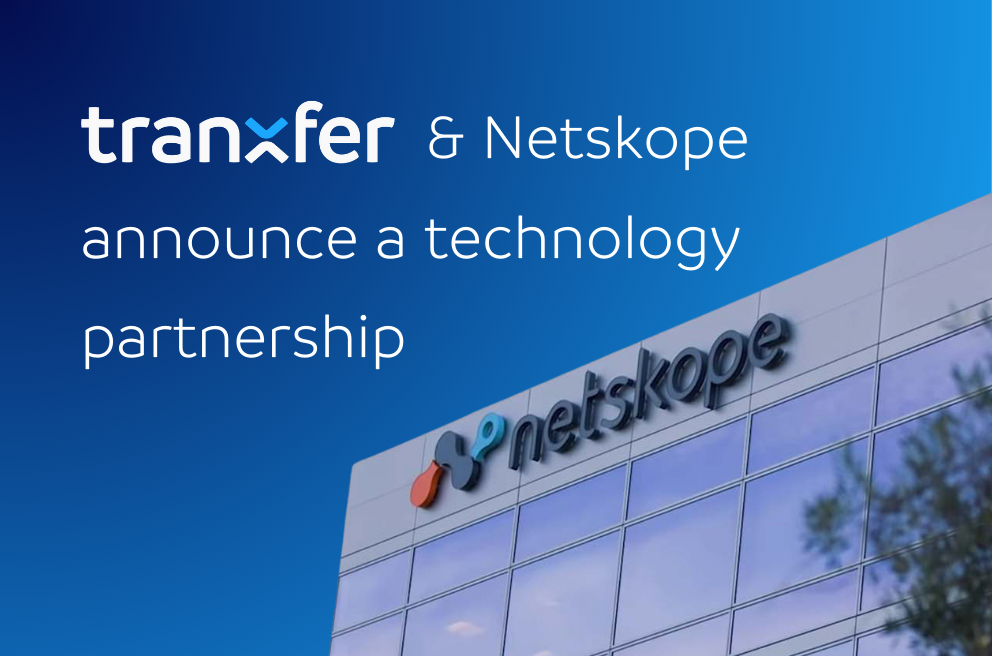
For this reason, Tranxfer announces its integration with Netskope DLP On Demand, expanding data protection capabilities across file transfers—both in internal workflows and external exchanges with third parties.
Consistent DLP policies, also in file exchange
This integration enables the application of advanced Netskope DLP policies directly to file transfers within Tranxfer, ensuring consistent data protection across one of the main risk vectors in corporate environments: the exchange of sensitive information outside traditional channels.
The objective is clear: extend existing DLP policies to a key “data in motion” layer where organizations have historically lacked visibility and control—without duplicating tools or redefining rules.
Netskope: a standard in cloud security (SASE/SSE)
Netskope is a leading platform in cloud-native security (SASE/SSE), used by large organizations to protect data and users in real time against threats across the web, cloud, and private applications. Its approach unifies capabilities such as CASB, ZTNA, SWG, and DLP under a single console, enabling policy enforcement without compromising user experience.
This is why the integration goes beyond a simple connector: it is specifically designed for organizations that already use Netskope as their DLP standard and want to extend that control to secure file exchange, while maintaining a consistent security architecture.
Reducing Shadow IT: when blocking drives adoption
Beyond the technical integration, this release reinforces a key concept: closing the gap between control and adoption, particularly in the context of Shadow IT.
When security teams restrict unauthorized services (such as WeTransfer, Dropbox, or WhatsApp Web), users often turn to alternative, equally uncontrolled tools. With Tranxfer, blocking becomes an opportunity for adoption: users understand the reason behind the restriction and are redirected to an approved corporate channel designed for secure, frictionless file exchange.
Additionally, security teams can configure predefined messages in restricted-access pop-ups to guide users toward the approved alternative, reducing the use of uncontrolled channels and improving user experience.
An integration designed for enterprise environments
The integration is built on a simple principle: respect the customer’s security model. Tranxfer consumes and enforces existing Netskope DLP profiles, without creating or managing policies externally. This ensures consistency in data governance while avoiding operational complexity.
The result is an advanced, integrated, and governed DLP protection layer that extends Netskope capabilities to secure file exchange—without changes to workflows and with the level of control required in regulated environments and mature security architectures.
More information
Learn more about Netskope and its SASE/SSE approach: https://www.netskope.com
- Download the Tranxfer + Netskope DLP On Demand one-pager here