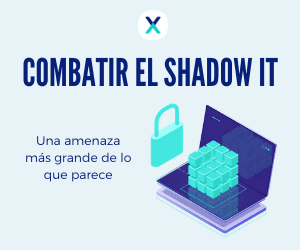
Shadow IT is a problem faced by companies worldwide and can pose a greater threat than it appears to be. Every company provides its employees with equipment and software, but many of them also download and install other programs that are not monitored by the IT department. According to IBM Security, one-third of employees share and upload corporate data to tools outside the organization. This is where Shadow ITcomes into play, primarily due to cloud storage applications, unauthorized networks, unmonitored computers, or third-party SaaS applications. Approximately 82% of companies are unaware of all the applications used by their employees in their day-to-day work.
PROBLEMS
With remote work, employees have had to use their own devices, which were not monitored by the company; and in the absence of oversight, they have been able to access uncontrolled third-party applications. It is worth noting that only 7% of free SaaS applications on the internet meet minimum security standards, so people who use them unwittingly expose the organization to risk.
Banks and insurance companies are the organizations most at risk from shadow IT, as they cannot send sensitive information via platforms like WeTransfer. It is one of the most widely used applications for file transfer, but what many people overlook is that everything sent is stored in the cloud. The information remains fully accessible in the event of cyberattacks, and users also face potential penalties.
CONSEQUENCES
This situation can present companies—and particularly the CISO, who oversees information security—with a challenge in identifying the source of the data breach. Other consequences of shadow IT include slow processes due to the use of unapproved tools. Additionally, devices that do not use company-provided hardware are at increased risk of cyberattacks. According to studies, approximately 50% of IT budgets are spent on resolving problems caused by Shadow IT in companies.
HOW TO AVOID IT
To prevent shadow IT, there are various best practices that the CISO can implement within the company, such as identifying and monitoring all devices and tools that employees will use. This way, not only is the occurrence of Shadow IT minimized as much as possible, but if it does occur, it will be easier to trace its source. It is not an easy task, but it is a necessary one. Next, the risk and suitability analysis—that is, analyzing the tools available to employees and assessing whether they are appropriate. If they are not, seek out new, valid tools in line with the IT and cybersecurity strategy. Last but not least, it is essential to raise awareness among all employees of the importance of information security. It is the weakest link, and human error is becoming increasingly common in the digital world.
Tranxfer includes advanced security policies and an easy-to-use user and administrator interface. Along with the
SIEM integration, Tranxfer also offers traceability reports, ensuring that everything entering or leaving the perimeter is monitored. It also provides auditing capabilities, so the tool’s deployment can be customized to adapt and integrate with the specific characteristics of each company’s environment and system. We emphasize that all transfers comply with GDPR regulations. In addition to technical benefits, the platform offers practical advantages.
With Tranxfer, you can send files with no size limit, securely and without them becoming public on the internet. You also have the option to send a file so that the recipient can only view it with a watermark. Unlike WeTransfer, which only offers a download option.
Contact Tranxfer to enjoy a completely free trial. Just go to www.tranxfer.com
Download the infographic here
You might also be interested in our article Email Risks.