This Spanish startup aims to become a global leader in secure file sharing by 2022
Tranxfer has developed a B2B solution that allows company employees to send files and confidential information via an encrypted channel.
Miguel Planas, the platform’s founder, is confident that his solution will become a global leader in the file storage and transfer industry within two years.
He acknowledges that during the pandemic, business continuity has been prioritized over cybersecurity, though he notes that he fully understands why.
With the pandemic, companies and employees were forced to work remotely. One of the unresolved issues was how workers could securely send sensitive information and files to one another. Many firms turned to services like Google Drive or Dropbox for this purpose. There are also alternatives such as WeTransfer.
With the sudden rise of remote work, most industries prioritized business continuity over cybersecurity. This is one of the reasons why the cybersecurity sector is experiencing a turning point in 2020.
The same can be said of Tranxfer. This Barcelona-based startup has developed a service for sending and receiving sensitive information with end-to-end encryption. It is already a tool used by major Spanish financial institutions and Ibex 35 companies such as Naturgy.
They recently announced a €1.5 million investment to further their international expansion. Miguel Planas is the president of Iris Venture Builder, the holding company that owns this new firm. He is ambitious. He explains to Business Insider Spain that they aim to offer their clients “the world’s most secure solution” for sending files. Other alternatives are not always secure.
To that end, Planas is confident that his tool will eventually rank among the top five most widely used file-sharing solutions in the world. And that, of all of them, it will be the most secure. He believes he has what it takes to make that happen. He already has the technology. He also has a team of engineers, primarily in telecommunications.
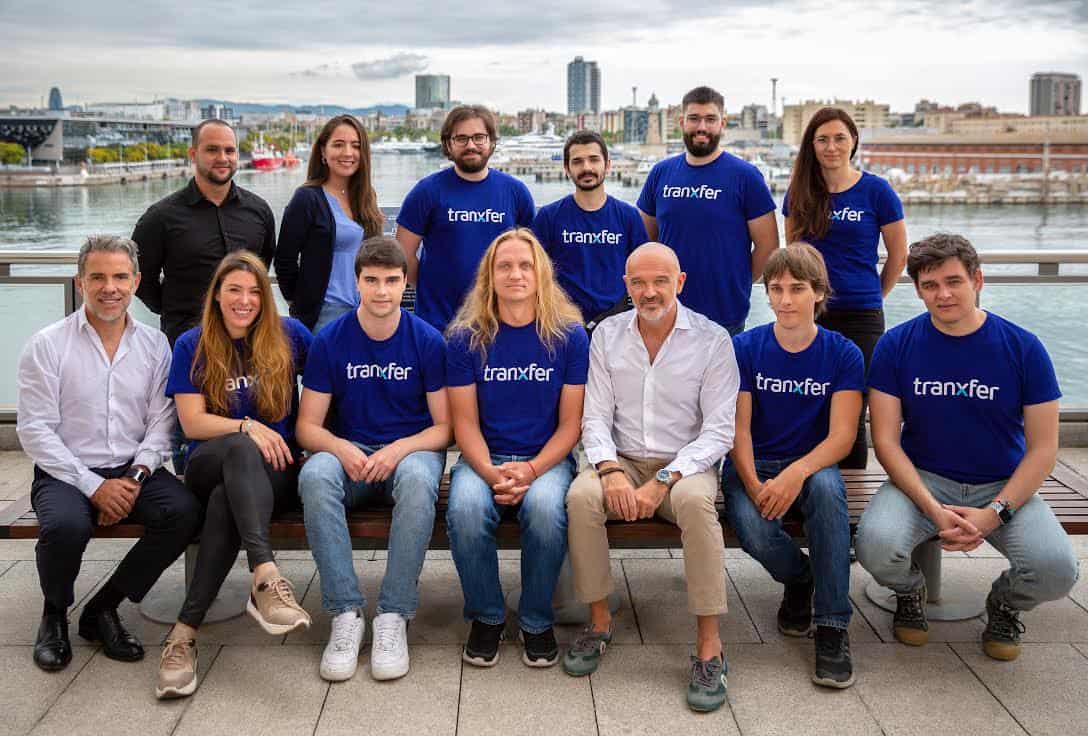
Tranxfer’s model breaks from the conventional mold of new tech firms. They don’t want to burn through cash. Their workforce is mature. Excluding interns, there are about fifteen people over the age of 40. And they’ve just hired a Belgian sales director with whom they plan to expand primarily into Central Europe and the United Kingdom.
It is precisely this conservative strategy that is becoming their main selling point for attracting and retaining major clients from Spain’s leading stock index. Planas emphasizes: at the start of the pandemic, many of these large companies even had to resort to email to handle sensitive information.
Many bank branches had to continue operating remotely and conducting transactions via email, with the risks that entails—many of which were detailed by Chema Alonso, the head of Digital Customer and a Spanish hacker, in a recent talk.
“Email is for sending messages, not for sending sensitive or confidential information. If there was already misuse of email before, we can imagine what it’s like now,” notes this professional, who has been working in the field of cybersecurity for nearly a decade and a half.
“I think it’s right that business continuity was prioritized”
The pandemic hit Europe and Spain suddenly, and within a matter of days, many companies made the switch to remote work. Even so, Planas fully understands that most companies chose first to ensure business continuity and only later to prioritize security.
“And this is coming from a guy who sells security,” he maintains.
“If you shut down the business, what are you going to secure afterward? Companies like financial institutions are critical infrastructure,” he recalls. He understands that it is essential for them to prioritize business continuity and then immediately focus on cybersecurity. “Ideally, both should happen at the same time,” he reflects. “But I can’t criticize the decisions that were made at the time.”
Thus, Planas hopes that Tranxfer will become as indispensable for sending files as Meet or Teams are for holding remote meetings. “A tool for sending information that cannot be intercepted.”
The startup was born after Planas, at the helm of Iris Venture Builder, met with a major Spanish bank that was seeking a solution for secure file sharing. They wanted to combat the use of Shadow IT at all costs—any type of program or device used by employees for professional purposes but not approved by the company’s IT managers—.
Finally, after developing the solution, Planas realized it was scalable, and that’s how Tranxfer was born as a B2B firm that opens the door for small-scale professionals—such as an architect who wants to securely store or send their blueprints—to make use of this technology.
“Users don’t need to download a client.” Although it is an end-to-end encryption tool, Tranxfer’s development has made it a service that requires no installation on the computer. It began to be marketed in 2017, and in 2019, the firm’s major clients—including Naturgy—came on board.
“By January of this year, we already had the tool—in our view, based on the testing we put it through—at a more advanced stage. And now we’re stepping on the gas.” Planas highlights how a 1.5 million euro injection—1 million from the parent company, Iris Venture Builder; and 500,000 euros from a bank loan—will help them expand internationally, starting in Europe.
Nevertheless, Planas remains committed to the goal of becoming a “global leader” by 2022. “It’s local technology with the capability and leadership to stand up to large international corporations.” The ‘David’ that aims to unseat the “Goliaths” of this industry.
Interview conducted by Business Insider.
You might also be interested in the interview by Computing.