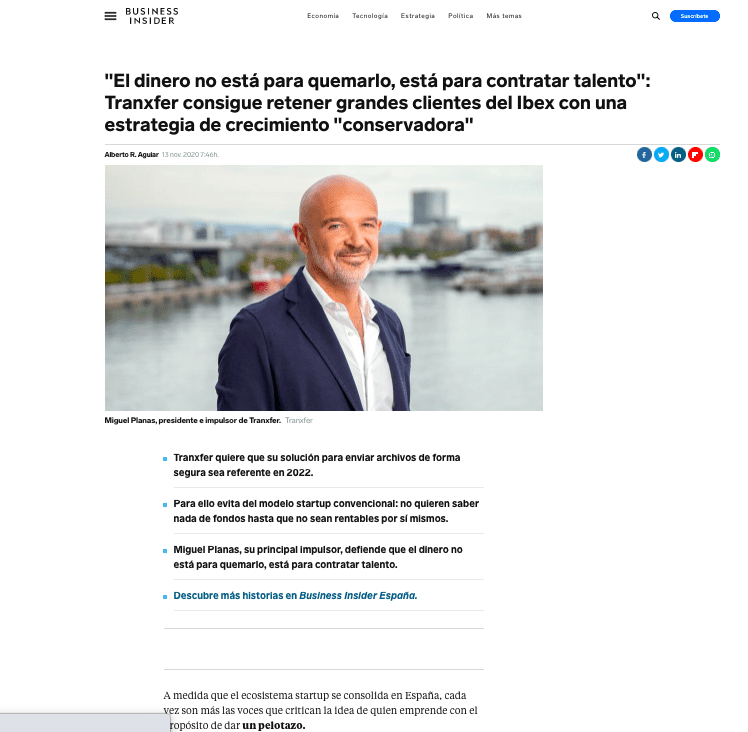
“Money isn’t meant to be burned; it’s meant to hire talent”: Tranxfer manages to retain major Ibex clients with a “conservative” growth strategy
A few days ago, Business Insider magazine interviewed Miguel Planas, CEO of Tranxfer, revealing the “conservative strategy” the company is using to reach its 2022 goal of becoming a global leader.
Read the full interview: Business Insider
As the startup ecosystem takes root in Spain, more and more voices are criticizing the idea of entrepreneurs who start businesses with the sole purpose of striking it rich.
Tranxfer, a Spanish startup specializing in solutions for sending and receiving files via secure channels, aims to become a global leader by 2022.
Its main driving force is businessman Miguel Planas, president of Iris Venture Builder. He exudes ambition in an interview with Business Insider España, in which he also surprises by revealing his “conservative strategy” for achieving his goal.
“We prevent other funds from coming in. Even if a fund comes in with a minority stake in the company, they often impose draconian conditions,” he reveals. “They inject huge amounts of money, of which a very high percentage ends up being burned through. And both funds and executives are complicit in this.”
Without pointing fingers at anyone, Planas acknowledges that his views may be controversial in a year when the startup ecosystem can boast impressive figures thanks to the forced digitalization brought about by the COVID-19 pandemic. Even at more established companies, such as Idealista, there have been multimillion-dollar corporate transactions that have marked a turning point.
But Planas insists. “Money isn’t meant to be squandered,” he stresses. “When the money you invest is your own, you manage it much better.” That’s why Tranxfer issued a recent press release claiming to have secured a 1.5 million euro injection. Here’s the catch: one million came from its parent company, Iris. The 500,000 euros is a bank loan.
“The money is only for hiring talent,” recalls the entrepreneur, who also notes that when there is too much money, it contributes to “a decline in the existing talent.” “With scarce resources, people are more talented.”
Planas believes that when a fund invests in a startup in its early stages, the founders often lose control. Sometimes, when it all ends in bankruptcy, the founders and the fund are unable to see eye to eye.
In any case, this doesn’t mean that Tranxfer rejects the entry of funds. But at least, for now, no. “Only when we’re making money. When they help us scale globally.”
“It seems like a lot of people start companies just to sell them. At Iris, we started in 2011 and haven’t sold one yet. Obviously, selling makes sense when, on a personal level, it’s a legitimate decision because you have other personal or professional projects. Or because the company has reached a size where you don’t see yourself staying on board, and you believe another player can do a better job,” he clarifies.
But Tranxfer’s goal is to “make money, the sooner the better” and grow sustainably.
A strategy with a different set of risks
It is precisely by adopting this somewhat “conservative” strategy that they have been able to secure loans and financial investment, as well as attract—and retain—major clients from the Ibex 35, notably Naturgy.
But the fact that they aren’t growing at breakneck speed like more conventional startups—burning through cash and receiving massive injections of capital—can entail another set of risks. One is that another firm could get ahead of them by providing a similar solution in the market that scales much more quickly.
“We have that fear. Since we haven’t raised funding, and since we’re moving at our own pace , someone else could step ahead. But I think the risk of losing our minds is greater: we feel more comfortable with this model.” “It’s a conservative strategy,” Planas acknowledges. “But customers like it too: they feel reassured by our track record.”
In short, the entrepreneur asserts: “We’re not twenty-somethings.”
How do we envision the evolution of the workplace over the next two years?
At Tranxfer, we foresee an evolution of the workplace that can be summarized in three key areas: user experience and productivity, trust in the cloud, and security and compliance. Now more than ever, users can connect via multiple devices, which can lead to data leaks in the absence of Zero Trust. This concept requires a shift in mindset on the part of IT, so that all devices are treated as potential threats and can be controlled. We believe there will no longer be room for the notion of “not cloud-based,” so companies will increasingly work remotely. Zero Trust will be a necessity.
This technological transformation has been accelerated by the pandemic, but it was inevitable.